

My first full-time job out of college was working for the San Diego Zoo’s CFO, Paula, on a small internal innovation team exploring sustainability, biomimicry, and conservation tech. New ways to connect people and product with biodiversity, or as we formally reported, “mission-aligned revenue generation.” Paula ran a ~$200M annual budget, though she often introduced herself in meetings as a “bean collector.” Humble and full of grit, she had a rare gift for finding signal amidst the noise. She didn’t get stuck on the old way of doing things, or swept up chasing every new idea. She kept her eye on the prize, or vision as it were.
Maryana Iskander reminds me of Paula. They’ve never met.
I’ve been a fan of Maryana for years. Whenever our paths cross, I have the same thought: woah. What an authentic and clear leader. Someone who knows why she’s in the room, can cut through a ranging conversation, and gets meaningful things done.
We recorded this episode about six months after Maryana stepped down as CEO of the Wikimedia Foundation (the nonprofit behind Wikipedia). As you’ll hear, she is direct and practical in how she sees and leads. She’s held a wide range of leadership seats: on boards, scaling an NGO from the inside, navigating a federation model amid political tension and financial strain. Different entity structures, same through line — enabling groups with little hierarchy to function well together.
Wikipedia felt like the right place to begin this Season because it’s such a clear example of leading without controlling: a system built to allow ebbs and flows rather than resist them. The fluidity isn’t just an interesting detail here. It’s the whole model.
It’s also a case of hidden legibility: Almost everyone uses it. Almost no one thinks about how it actually works. As Maryana shares, there’s a lot to learn about the organization behind it, but the core work remains fairly mysterious. Thousands of independent editors, spread across time zones and languages, building something we now treat as a default source of truth even in the age of AI... How do they sustain such a wide network?
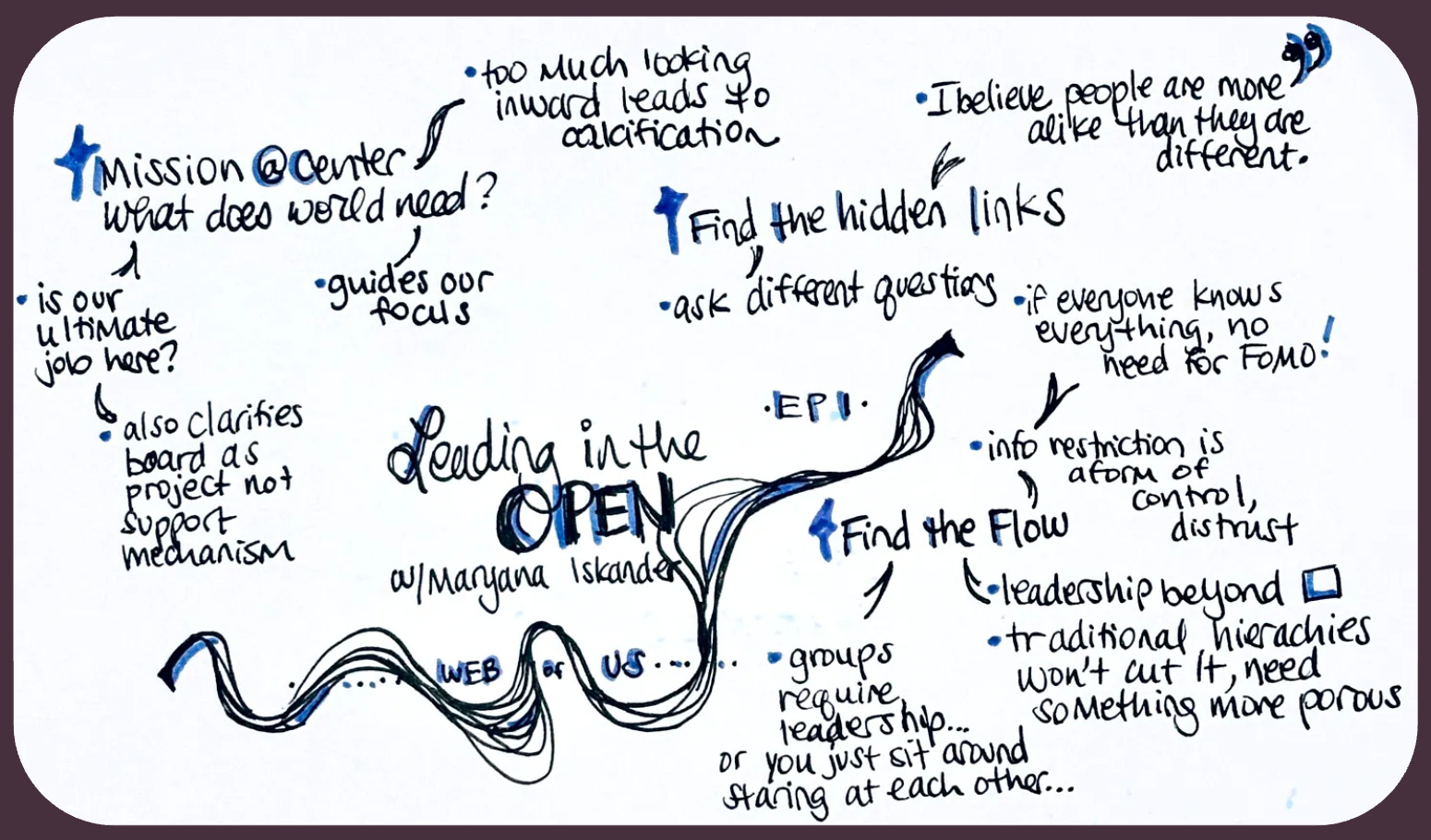
A few themes… welcome to how my brain maps.
She calls it being porous: leading with the will to work outside your own four walls, alongside people you don’t control.
A few threads I love in our conversation:
Leadership and networks aren’t mutually exclusive. You need both, the approach, vibe, and time frame of that leadership might just look different.
Simple is still true. Collective efforts can’t sustain without strong basics: vision and goals, clear communication, governance and decision making transparency.
Information as control. Often withholding information is a form of control: without clarity on why or how, no one is sure where permission actually sits. It concentrates power and suffocates agency.
What struck me most, though, wasn’t the frameworks. It was the small admissions. She was surprised. She didn’t know. She had to ask someone else. Those moments are easy to skip past, but I think they’re exactly why people want to work for her, work with her. It’s network practice, embodied. Not performed expertise, but someone actually still learning in real time.
You’re in for a treat. Listen to Web of Us wherever you get your podcasts.
Field Notes: Same Bet, Different Contexts
Researching Wikipedia’s decentralized model, a range of other systems popped up. Some you likely know, others perhaps not. Some digital, some even made of cardboard.
Volunteer-run with no one in charge:
Linux kernel: thousands of contributors, no employer, coordinated by trusted maintainers
Alcoholics Anonymous: leaders are “trusted servants,” not authorities
OpenStreetMap: volunteer-mapped, edited by anyone, same bones as Wikipedia
Businesses testing the same instinct:
Mondragón: world’s largest worker cooperative, 80,000+ people, one worker, one vote
Handelsbanken: 800+ bank branches, each running its own books
Valve: no formal managers, desks on wheels, people choose their own projects
Zappos: adopted Holacracy, roles rotate instead of sitting fixed
Fairtrade International: nearly 2 million farmers and workers across 70+ countries, half the voting power reserved for producers themselves
Eloísa Cartonera: after Argentina’s 2001 collapse, writers and cardboard collectors started a publishing cooperative, hand-binding books from salvaged cardboard. Dozens of sister presses now exist across three continents.
A system can hold together without anyone holding it tightly. Where have you seen that?
I love how Maryana is both a dreamer and a pragmatist and holds the two up together in equal regard. Love the bit where she says that “information flow is one of the biggest strategic levers for alignment, momentum, getting rid of hierarchy, silly power games, because people use and withhold information typically in organizations as a way of creating distance or power.” But also acknowledges you need leadership. Great things don’t just happen by accident. “I think I have concluded that without leadership you can't solve big problems. And so how do you make leadership be the most authentic idea?”. GREAT EP and so happy Web Of Us is back 💖
Absolutely love your mind maps Claire. ❤️